I bridge the fields of galactic astrophysics and cosmology by finding novel correlations between objects in the non-linear regime of galaxy dynamics,
such as galaxies and galaxy groups, and the large-scale structure of the Universe. I am interested in refining ways to quantify these correlations and
exploring the additional cosmological information they reveal in large spectroscopic surveys like DESI. This page hilights some of my most recent projects.
My ADS Library
Multiplet Alignment
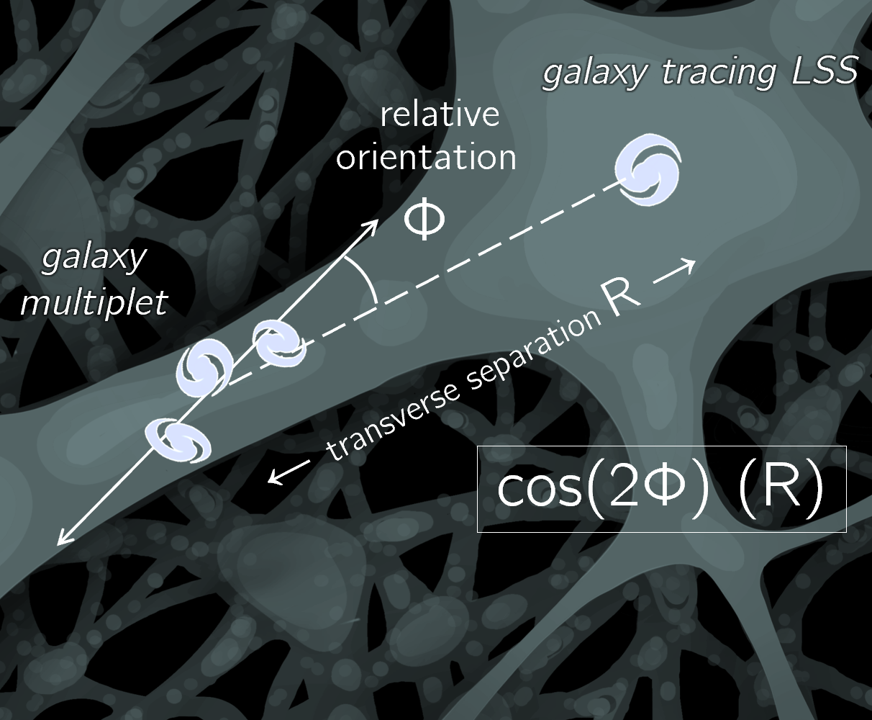 Gravitational forces from the largest structures in the universe leave a detectable imprint
on galaxies and their local environment. This can manifest as the 'intrinsic alignment' of galaxy orientations to the large-scale tidal field. Although considered a
nuisance for weak lensing, these correlations uniquely encode cosmological information sensitive to the physics of the very early universe. However, applications are
limited due to the challenges of imaging the shapes of individual galaxies and the fact that alignment is not observed in blue or faint galaxies. We circumvent these
issues by instead considering the orientation of small sets of galaxies, or 'multiplets'. Most recently, we've used this method to detect intrinsic gravitational shear
on the largest scales yet, over 200 Mpc/h.
Gravitational forces from the largest structures in the universe leave a detectable imprint
on galaxies and their local environment. This can manifest as the 'intrinsic alignment' of galaxy orientations to the large-scale tidal field. Although considered a
nuisance for weak lensing, these correlations uniquely encode cosmological information sensitive to the physics of the very early universe. However, applications are
limited due to the challenges of imaging the shapes of individual galaxies and the fact that alignment is not observed in blue or faint galaxies. We circumvent these
issues by instead considering the orientation of small sets of galaxies, or 'multiplets'. Most recently, we've used this method to detect intrinsic gravitational shear
on the largest scales yet, over 200 Mpc/h.
Detection with DESI DR1: Full Paper | Accessible Summary
Largest scales with DESI DR2: Full Paper | Accessible Summary
Enhancing with imaging (student paper by Alexus Annika Kumwembe): Full Paper
Intrinsic Alignments
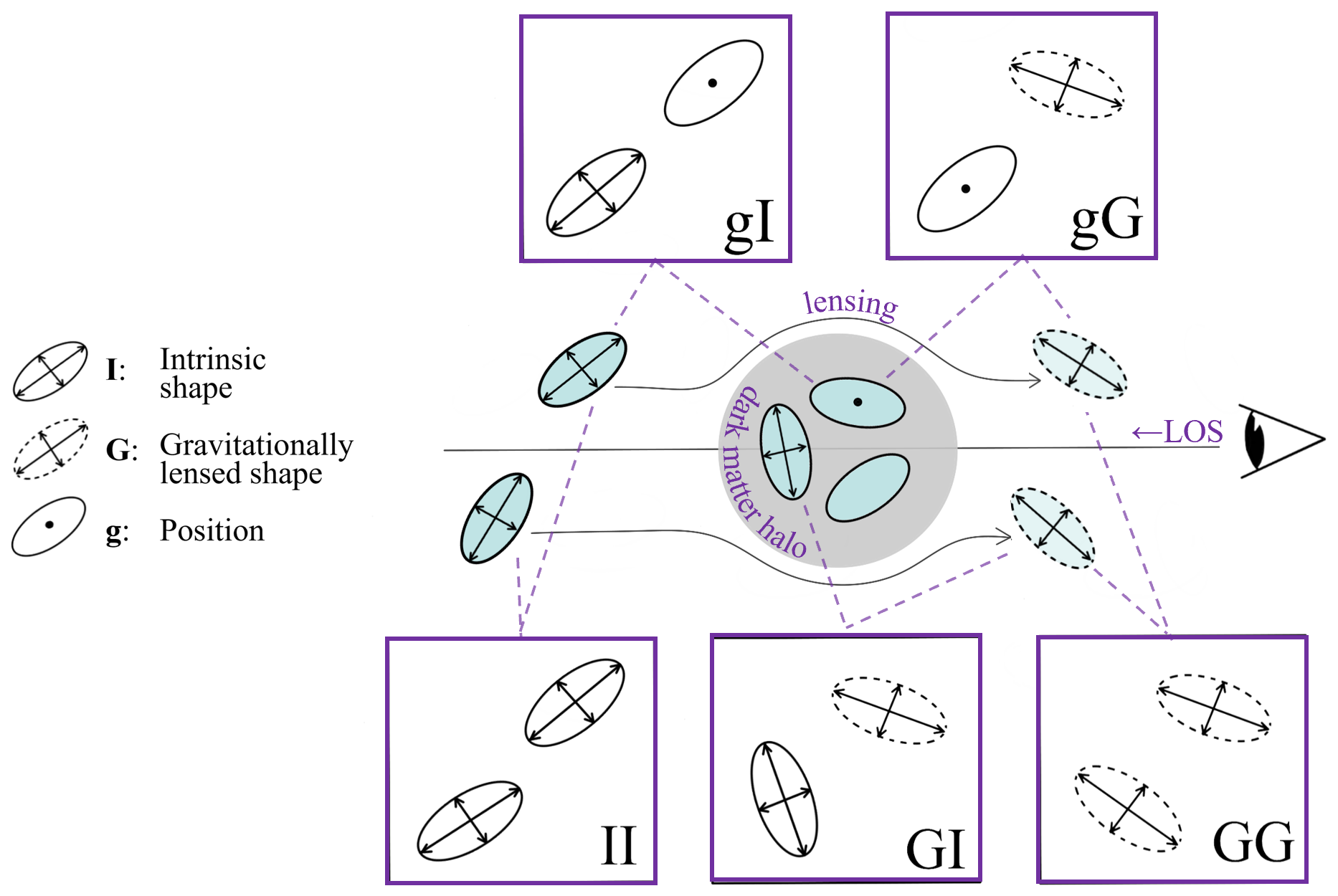 Intrinsic Alignments (IA) refers to physical correlations involving galaxy shapes, galaxy spins, and the underlying cosmic web. Its characterization is an important aspect of modern cosmology,
particularly in weak lensing analyses. I collaborated with a team of other IA experts to create a guide to common notations and concepts in the field. This resource is both a reference for those
already familiar with IA and designed to introduce someone to the field by drawing from various studies and presenting a collection of IA formalisms, estimators, modeling approaches,
alternative notations, and useful references. I have also developed optimal estimators for measuring IA in large spectroscopic surveys, which efficiently capture line-of-sight
information while remaining relatively insensitive to redshift-space distortions.
Intrinsic Alignments (IA) refers to physical correlations involving galaxy shapes, galaxy spins, and the underlying cosmic web. Its characterization is an important aspect of modern cosmology,
particularly in weak lensing analyses. I collaborated with a team of other IA experts to create a guide to common notations and concepts in the field. This resource is both a reference for those
already familiar with IA and designed to introduce someone to the field by drawing from various studies and presenting a collection of IA formalisms, estimators, modeling approaches,
alternative notations, and useful references. I have also developed optimal estimators for measuring IA in large spectroscopic surveys, which efficiently capture line-of-sight
information while remaining relatively insensitive to redshift-space distortions.
The IA Guide: Full Paper | IA Cheat Sheet
Optimal IA estimators: Full Paper | Accessible Summary
IA as an RSD Bias
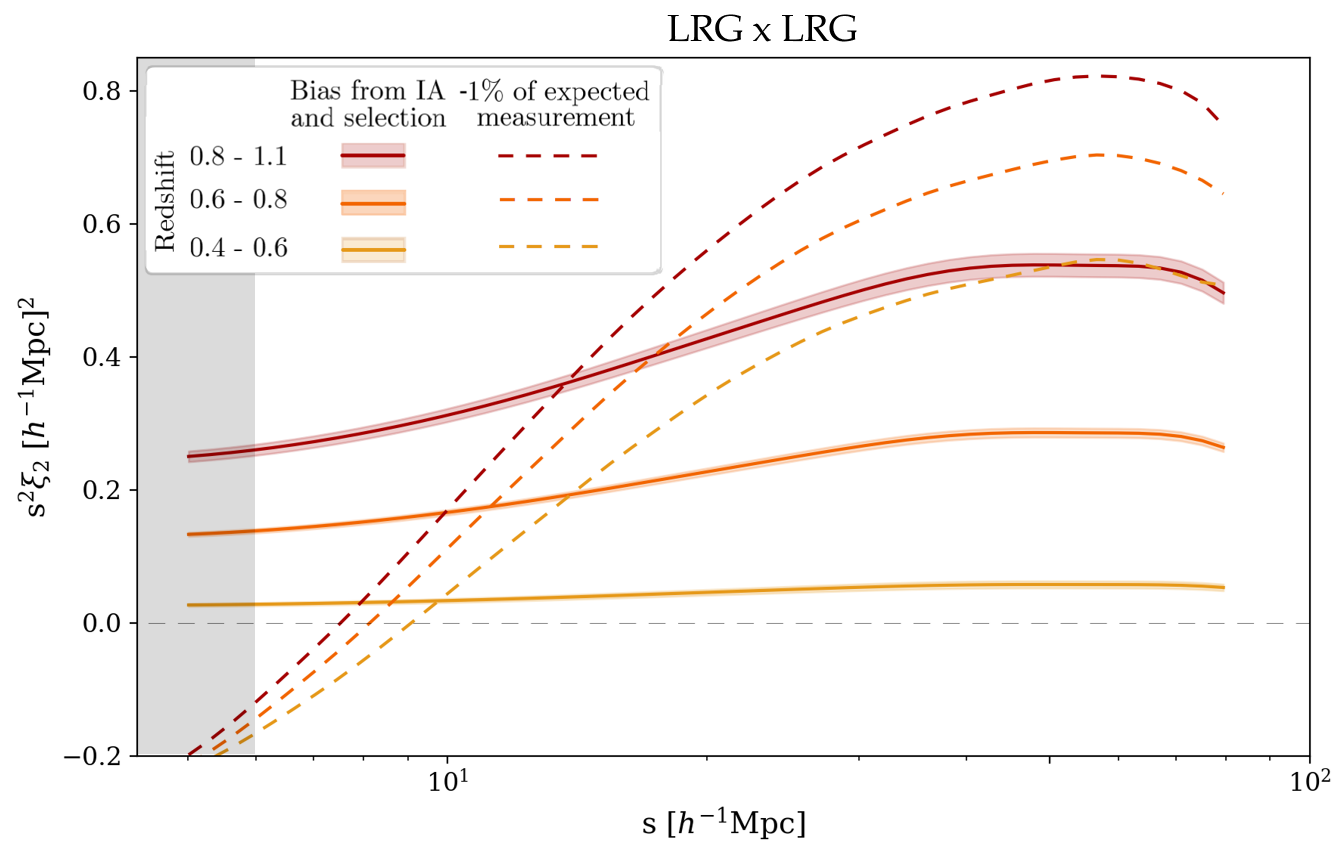 IA can
significantly affect RSD measurements in large surveys like DESI. This arises due to an
orientation bias in DESI’s target selection, which is based on the galaxy light that falls within
a fiber aperture. This gives rise to anisotropic clustering in DESI’s galaxy
map, mimicking the same patterns used to measure RSD and the growth rate of structure. My work reveals a strong redshift dependence of this bias as fainter, redder galaxies are closer
to the selection cut and therefore more affected. It can bias measurements of RSD by about
1%, well above DESI’s required total constraint of around 0.5%. Without my corrections,
DESI would underestimate the growth rate of structure, biasing determinations of dark
energy’s strength and evolution
IA can
significantly affect RSD measurements in large surveys like DESI. This arises due to an
orientation bias in DESI’s target selection, which is based on the galaxy light that falls within
a fiber aperture. This gives rise to anisotropic clustering in DESI’s galaxy
map, mimicking the same patterns used to measure RSD and the growth rate of structure. My work reveals a strong redshift dependence of this bias as fainter, redder galaxies are closer
to the selection cut and therefore more affected. It can bias measurements of RSD by about
1%, well above DESI’s required total constraint of around 0.5%. Without my corrections,
DESI would underestimate the growth rate of structure, biasing determinations of dark
energy’s strength and evolution
Initial Publication: Full Paper | Accessible Summary
With DESI Y1 spectra: Full Paper | Accessible Summary
Miscellaneous
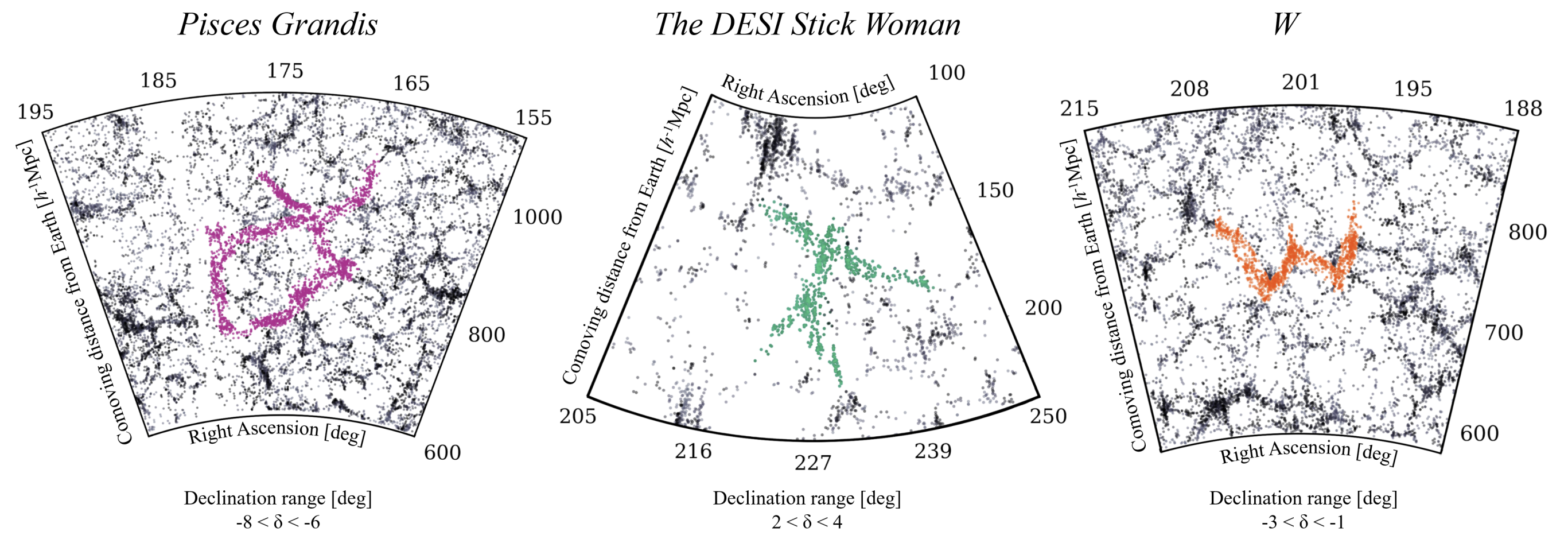 Presenting galactic constellations: charming shapes in large cosmological surveys. We analyze the size of these constellations as an unconventional probe of homogeneity,
finding consistency with the cosmological principle and Lambda-CDM. This was a special paper for April 1st, but everything in it is scientifically defensible.
Presenting galactic constellations: charming shapes in large cosmological surveys. We analyze the size of these constellations as an unconventional probe of homogeneity,
finding consistency with the cosmological principle and Lambda-CDM. This was a special paper for April 1st, but everything in it is scientifically defensible.
Galactic Constellations in DESI DR1: Full Paper | Galactic Constellations Website